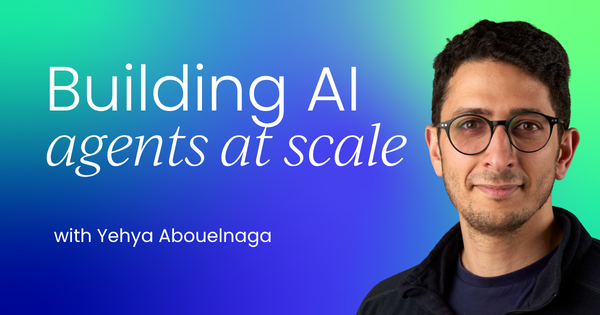

I'm Yahya, an engineer at Lovable, and over the past few months I've been working on a use case that taught me a lot about what it actually means to build an agent and, more importantly, what happens when you try to optimize one at scale.
Let me walk you through it.
What Lovable does (and who it's for)
Lovable is an AI tooling company. We have around 70 million apps on our platform, and the people who use us are mostly non-engineers. They don't know what tokens are. They don't care about model architecture. They come to us with an idea, and they expect a working app on the other side.
The promise we make is straightforward: describe what you want, and the agent builds it for you. As efficiently as possible. As cheaply as possible. Secure by default.
That last part matters more than people might initially assume.
To make this concrete, I'll use an example I actually ran during my presentation. I took the conference agenda for today's event, fed it into Lovable, and asked it to build me an app that shows all the sessions happening today. It read the website and built the app. Simple enough.
 Andrew Lovell
The MCP use case
Now here's where it gets interesting. The use case we've been working on for the past three months is giving users the ability to talk to their Lovable apps through an agent.
So you'd go to Claude, or Codex, or whichever agent you prefer, and ask it something like "what's on the agenda today?" and it would pull that information directly from your app.
To make that work, you need something called an MCP. An MCP is a protocol that allows an app to communicate with an agent. Think of it as the bridge between your app and whatever AI assistant someone is using.
To show how this works in practice: I built a site, then told Lovable I wanted speakers to be able to connect to it using Claude. Lovable understood what I was asking for and created the MCP.
From there, you copy the link, connect it in your agent, authenticate, and you're talking to your app. You can ask what's on the schedule. You can ask what you're presenting. You can even ask it to draft an abstract and upload it directly to the app.
That's the happy path. And it's genuinely impressive when it works.
But getting it to work reliably, across 70 million apps, across different models, across different users with different needs? That's where things get complicated.
For expert advice like this straight to your inbox every other Friday, sign up for Pro+ membership.
You'll also get access to 300+ hours of exclusive video content, a complimentary Summit ticket, and so much more.
So, what are you waiting for?
The questions an agent has to get right
To build an MCP properly, an agent needs to answer a set of questions correctly, and it needs to get them right from the first attempt.
- Which library should it use?
- Where does state live?
- Does it need to build authentication?
- How does it enforce that authentication? If there are 100 tools in the MCP, it can't just detect 70 of them.
- And how does it enforce authorization so that user A can't access user B's data?
These aren't trivial questions. And if you leave the agent to answer them without guidance, it can hallucinate in a hundred different directions.


AI accelerator insider insider
Thank you for subscribing
Level up your ai accelerator insider career & network with ai accelerator insider experts.
An email has been successfully sent to confirm your subscription.
 Follow us on LinkedIn