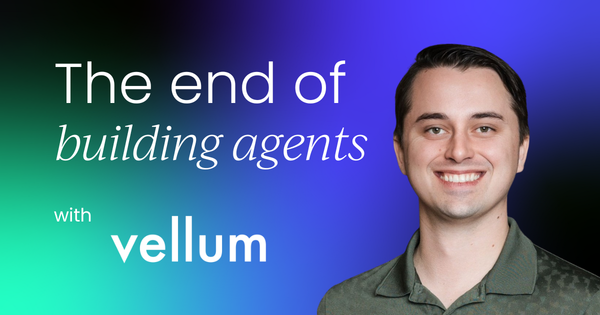

You know that moment when you realize you've been solving the same problem over and over? That's where I found myself about a year ago. My name's Noa Flaherty, and I'm the CTO and co-founder of Vellum. After three years of building tools for AI development, I had this wild thought: what if we just built an AI agent that could build other agents?
Sounds meta, right? Maybe even a bit ridiculous. But here's the thing: it actually worked. And the lessons we learned along the way? They're worth sharing, whether you're an engineer knee-deep in code, a business leader trying to figure out AI adoption, or somewhere in between.
The death of drag and drop (and why that's okay)
Let me be straight with you: drag and drop is dead. I know, I know, we spent two whole years building these beautiful low-code editors at Vellum. Those workflow diagrams looked great in demos. Click here, drag there, connect these boxes, and voilà, you've got yourself an AI system.
But here's what we discovered: it's clunky. Error-prone. And the moment you need to build something real, something that actually solves complex business problems, those pretty diagrams become a nightmare to manage. Any system worth its salt requires technical understanding that makes drag-and-drop interfaces feel like you're trying to perform surgery with oven mitts on.
Think about it. In 2025, we're all chatting with ChatGPT like it's our coworker. We expect that instant gratification, that natural back-and-forth. Why would we go backwards to clicking and dragging boxes around a screen?
On the flip side, you've got a million AI frameworks popping up every other week. LangChain, AutoGPT, CrewAI - pick your poison. But betting your company's future on any single framework feels like building a house on quicksand. What happens when the next shiny framework drops and everyone jumps ship?
We're stuck in this awkward tension. You want to empower more people in your organization to build AI systems, not just the engineers. You want Karen from accounting to automate her workflows and Bob from sales to build his own lead qualification bot. But you also need the robustness and flexibility that only comes from code.
The answer? Natural language. It's the one interface we all understand.
For expert advice like this straight to your inbox every other Friday, sign up for Pro+ membership.
You'll also get access to 300+ hours of exclusive video content, a complimentary Summit ticket, and so much more.
So, what are you waiting for?
Tool definitions: the secret sauce nobody talks about
Here's lesson number one, and it might be the most important thing I share today: tool definitions really, really matter.
Traditional software loves APIs. Computers talk to computers through these neat, structured interfaces. But AI? AI prefers conversation. It wants to interact with systems the same way you and I would talk about them.
Let me give you a concrete example. Say you're building an agent that updates Salesforce records. The traditional approach would give your AI three separate tools: one to search for contacts, another to get contact details, and a third to update records. That's how APIs work: granular, specific, step by step.
But that's not how humans think. When I ask you to update a customer's information, you don't think "First I'll execute a search query, then I'll retrieve the detailed record, then I'll perform an update operation." You think, "I need to find and update this record."
So we started abstracting. Instead of three tools, we create one: find_and_update_record. Under the hood, it still does all three operations. But to the AI, it's just one coherent action. The AI thinks as a human would, and good old-fashioned code handles the nitty-gritty details.
 Andrew Lovell


AI accelerator insider insider
Thank you for subscribing
Level up your ai accelerator insider career & network with ai accelerator insider experts.
An email has been successfully sent to confirm your subscription.
 Follow us on LinkedIn