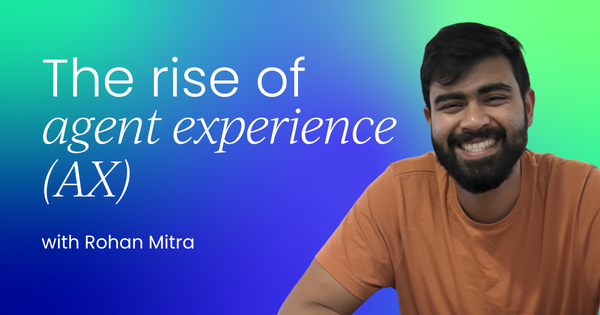

For thirty years, the most important aspect of product management has been the development of graphical user interfaces. We have learned how to capture the focus of users using visual hierarchy and remove friction from one click.
The user population is changing.
- Automated bots exceeded human-generated traffic on the Internet for the first time in a decade in 2025.
- Automated bots accounted for approximately 51% of all web activity (Imperva Bad Bot Report 2025).
- Automated crawler traffic increased fourfold - from 2.6% of verified bot requests in January to greater than 10% in September (Equimedia, 2025).
- By the end of 2026, Gartner estimates that 40% of enterprise applications will use task-specific AI agents.
- In early 2025, less than 5% of enterprise applications used task-specific AI agents.
Morgan Stanley estimates agentic commerce will account for 10 to 20% of U.S. e-commerce by 2030. Additionally, Morgan Stanley predicts the emergence of "agent search engine optimization" by 2026.
 AIAI
AIAI
What is agent experience (AX)?
Agent experience (AX) is the holistic experience an AI agent has when interacting with a product, platform, or digital environment. It covers everything from how an agent discovers what a product can do, to how it negotiates terms, executes tasks, and evaluates outcomes - all without a human in the loop.
Think of it this way: you've spent years optimizing for how a person feels when they land on your product. AX asks you to consider how an agent *reasons* about it.
Agent experience design is the practice of structuring your product so that autonomous agents can interpret it, trust it, and act on it. That means exposing machine-readable capabilities, defining clear confidence signals, and building endpoints that respond to goals rather than just commands.
Building an AI-first platform means treating agents as first-class users - not an edge case, not a future consideration. The products that'll win in the agentic economy are the ones being designed for both human and machine interaction right now.
The translation problem
A significant translation tax emerged within Moltbook.
Agents attempted coordination across various task types, including knowledge synthesis, negotiation, and basic trading, using human-style linguistic and visual communication.
This resulted in:
- Meandering, abstract discussions
- Failed coordination attempts
- High latency between interactions
- “Hallucinated transactions” that appeared productive but produced no real outcomes
The core issue was the absence of a standardized way to communicate capabilities and intentions.
While humans need a “Button” to express intent, agents need a “Handshake.”
Our current infrastructure, optimized for human perception, is becoming a bottleneck for machine-based intelligence operating at scale.
The dual-path approach
This shift does not signal the end of the screen. Humans will continue browsing, feeling, and choosing.
However, discovery, enjoyment, and loyalty remain experience-driven.
To address this, product developers must implement a dual-path architecture:
- Path 1 — UX (sensory path)
Optimized for human perception: emotions, aesthetics, storytelling, and trust.
This layer remains essential.
- Path 2 — AX (shadow UI)
Designed for agents: semantic, probabilistic, and action-oriented.
This layer allows agents to:
- Understand product capabilities
- Negotiate terms
- Complete transactions autonomously
No scraping. No manual navigation.
AIAI
AX vs API vs MCP
REST API
- Static integration layer
- Requires human developers
- Needs ongoing maintenance
AX layer
- Enables autonomous discovery
- Supports negotiation (price, delivery, constraints)
- Operates in real time
- Requires no human developer in the loop
Model Context Protocol (MCP)
- Standardizes tool connectivity
- Solves integration plumbing
AX sits above MCP
- MCP = infrastructure
- AX = architecture
Real-world examples of the agentic layer
Case 1: Klarna — Autonomous commerce at scale
Sector: Buy now, pay later / FinTech
Agentic layer:
AI assistant handling customer queries, refunds, and disputes end-to-end
Key outcomes:
- Replaced work equivalent to 700 full-time agents (first month)
- 2.3 million conversations handled in 4 weeks
- Resolution time reduced from 11 minutes to under 2 minutes
- Customer satisfaction reached parity with human agents
- $40M annual profit impact
AX principle:
Outcome-oriented endpoints
The results from Klarna demonstrate that when layers are sufficiently large and have strong semantic understanding at the endpoint, they can functionally replace human workflow layers.
Case 2: Salesforce Agentforce — The B2B handshake protocol
Sector: Enterprise SaaS / CRM
Agentic layer:
Autonomous agents managing CRM workflows and escalation
Key outcomes:
- 1,000 enterprise deployments in the first week
- 30–60% reduction in manual operations overhead
- 4,000+ weekly resolved cases (Wiley example)
- 40% case deflection rate
AX principle:
Probabilistic handshaking
Salesforce Agentforce is one of the clearest enterprise examples of probabilistic handshaking at the product architecture level.
Unlike systems requiring human oversight at every escalation point, Agentforce encodes escalation thresholds directly into the agent layer, making machine-to-human coordination part of the architecture rather than an afterthought.
Case 3: Amazon — Agent-native retail infrastructure
Sector: E-commerce / Retail
Agent layer:
Rufus AI handles complex product queries
Key outcomes:
- Handles multi-constraint queries
- 3.3× higher conversion versus standard search
- Agent-led checkout via “Buy for Me”
AX principle:
Semantic visibility
Amazon’s evolution highlights a strategic reality: the organization controlling the semantic visibility layer of e-commerce may ultimately control the default agent-shopping stack.
They have also structured the product information to be machine-queryable rather than simply human-readable, creating the foundation for agent-driven discovery, comparison, and checkout.
Case 4: Waymo — Autonomous logistics and the AX trust layer
Sector: Autonomous mobility / Logistics
Agent layer:
Vehicles negotiate with infrastructure systems in real time
Key outcomes:
- 1 million+ autonomous rides
- 6.8× fewer injury-causing crashes
- $5.6B funding round
AX principles:
Semantic visibility, probabilistic handshaking, and outcome-oriented execution
Waymo represents one of the most commercially mature implementations of the ANI framework to date. Its competitive advantage comes not only from sensors or neural networks, but from proprietary agent-to-infrastructure negotiation protocols operating as a fully integrated AX layer.
Andrew Lovell
Agent-native indexing (ANI)
ANI is a framework for building products that are:
- Searchable
- Understandable
- Transactable by autonomous agents
It shifts product design from tool-based interaction toward capability-based infrastructure.
1. Semantic visibility
Products expose machine-readable capability trees.
Example constraints:
- “No liquid shipping”
- “Signature required”
- “Next-day delivery within M25”
The capability tree becomes the agent equivalent of a product page, structured for machine reasoning instead of human scanning.
2. Probabilistic handshakes
Human consumers typically make binary decisions: buy or leave.
Agents operate differently. They rely on confidence thresholds when evaluating actions, counterparties, and outcomes.
AI-compatible products therefore need to expose:
- Historical performance data
- Reliability metrics
- Error probabilities
This transforms discovery from a catalog search into a probabilistic marketplace.
Salesforce Agentforce demonstrates this approach through threshold-based escalation systems. The next stage involves cross-platform interoperability, where agents compare reliability across multiple brands using standardized formats.
3. Goal-based endpoints
Traditional APIs revolve around verbs such as:
- GET /products
- POST /orders
ANI introduces objective-oriented interaction instead.
Example request:
“Provide carbon-neutral delivery by 4pm at the lowest possible cost.”
The system then:
- Interprets constraints
- Generates a plan
- Negotiates outcomes
- Returns an executable proposal
Klarna’s dispute resolution system demonstrates this model in practice. The client presents a goal, while the product layer determines how to achieve it internally without requiring users to navigate a GUI or rigid API workflow.
The strategic importance of the U.K.
The UK Government’s AI Opportunities Action Plan (January 2025) outlines 50 recommendations to position the UK as a global leader in AI.
This includes the creation of new organizations such as the AI Security Institute, which will receive up to £240 million in funding, alongside a regulatory approach based on principles rather than strict rules, designed to support innovation.
This is where frameworks such as Agent-Native Indexing (ANI) aim to contribute.
The opportunity
Across the commercial examples outlined earlier, a consistent pattern emerges: competitive advantage comes from architecture, not from the model itself.
Klarna derives its advantage from its endpoint design. Waymo does so through its agent-to-infrastructure negotiation layer. Amazon achieves it through a structured, machine-readable product graph. In each case, the differentiation is rooted in product architecture rather than model quality.
The UK’s strengths in financial services, logistics, and regulatory clarity provide a strong foundation to lead this layer of the stack.
If the UK aims to lead in the agentic economy, rather than simply in safe model development, it will need to invest in the middleware of machine commerce. This includes the standards and frameworks that allow digital products to be interpretable, transactable, and trustworthy for autonomous agents.
Conclusion: Closing the gap between user intent and product action
The examples of Klarna, Salesforce, Amazon, and Waymo represent a structural shift in how products operate.
The competitive advantage lies in:
- Architectural design
- Not model quality
Product management has moved beyond clicks and interfaces.
It now focuses on closing the gap between:
- User intent
- Product execution
The most important lesson from these case studies is that this gap is fundamentally a product problem, one that can be addressed through architecture.
Organizations that close this intent-to-execution gap first are likely to capture the majority of agent-driven commerce.
What this means for teams
To remain competitive, organizations should:
- Publish capability trees
- Define confidence thresholds
- Design goal-based endpoints
Data already shows that agents are becoming the dominant source of web traffic and are expected to continue expanding their economic footprint rapidly.
Product teams should begin developing an agentic layer now to ensure their digital products remain discoverable, trustworthy, and executable within machine-driven ecosystems.
Final thought
The question is no longer whether products need an Agent Experience.
It is whether they will build one first, and whether they will build it as architecture or as an afterthought.


AI accelerator insider insider
Thank you for subscribing
Level up your ai accelerator insider career & network with ai accelerator insider experts.
An email has been successfully sent to confirm your subscription.
 Follow us on LinkedIn