
In 2026, the region’s AI landscape isn’t defined by one company or one model. It’s shaped by infrastructure providers, frontier research labs, platforms that turn models into systems, and companies applying AI where failure actually matters.
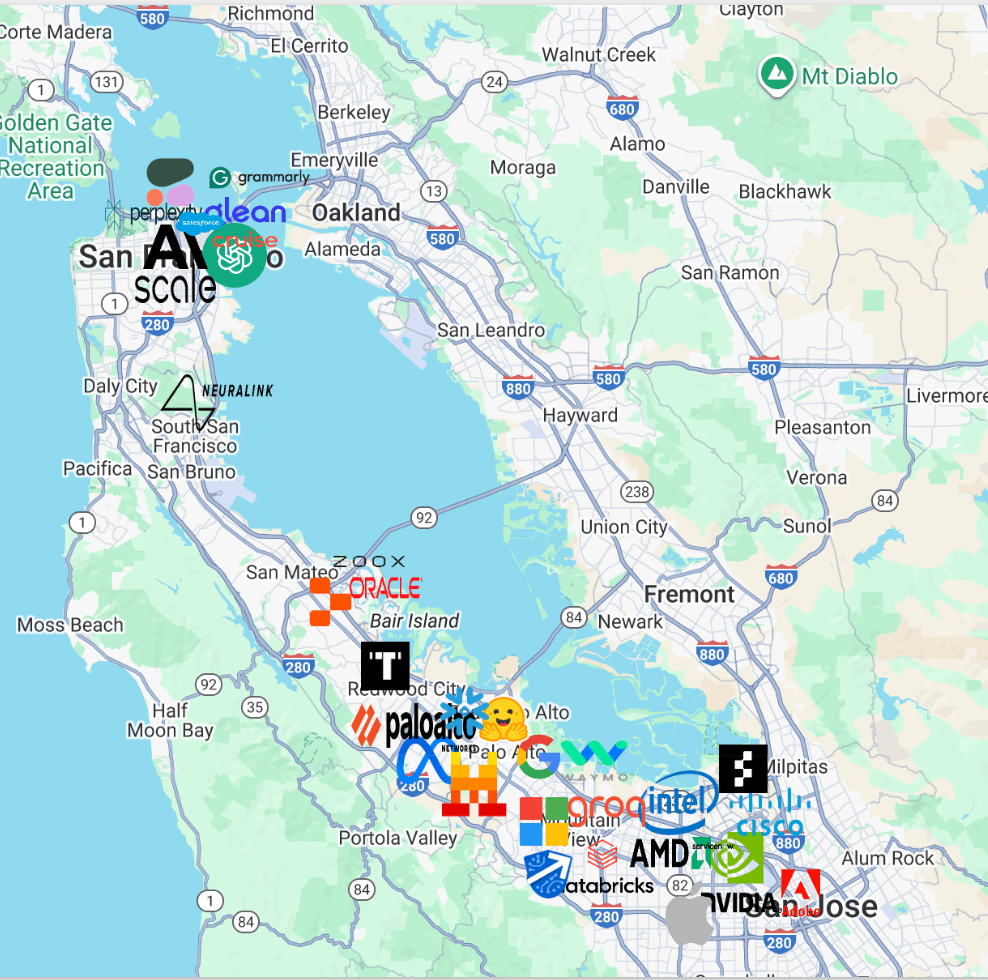
Here are 40 companies with major operations in the Bay Area that help explain why Silicon Valley still matters.
The infrastructure layer everything else depends on
Every AI system, no matter how impressive, eventually runs into the same question: what’s powering this? That’s where this group comes in...
- NVIDIA (Santa Clara). NVIDIA’s GPUs and software stack sit underneath most modern AI systems, a reality teams usually discover the moment they try to scale beyond a demo.
- Alphabet / Google (Mountain View). Google blends large-scale AI research with massive distribution across search, cloud, and consumer products.
- Apple (Cupertino). You may have heard of these guys. Apple focuses on on-device AI, optimizing for efficiency, privacy, and tight hardware–software integration rather than raw scale.
- Meta (Menlo Park). Ah, Mr Zuckerberg’s brainchild. Meta continues to shape open-weight models through Llama, while embedding AI across social platforms and immersive environments.
- Microsoft (Mountain View office). Like it or not, we all owe Microsoft in one way or another. It all started here. In 2026, Microsoft’s Azure AI and Copilot strategy anchors enterprise adoption, even if headquarters remain elsewhere.
- Intel (Santa Clara) Another O.G. Intel remains deeply involved in semiconductors and AI hardware, particularly for enterprise and edge workloads.
- AMD (Santa Clara). AMD is expanding its role in AI accelerators as competition in hardware heats up.
- Cisco (San Jose). Cisco integrates AI into networking, observability, and security — the less glamorous layers that quietly keep systems running.
- Adobe (San Jose). Adobe’s Firefly models bring generative AI into creative tools used by millions every day.
- Oracle (Redwood City office). Oracle continues embedding AI into enterprise cloud and database products, often behind the scenes.
 AIAI
AIAI
Frontier AI labs pushing capabilities (and limits)
On top of that foundation sits a group focused on advancing model capability itself. If the above was the sponge of the cake, these are the jam.
- OpenAI (San Francisco). You could argue that OpenAI put AI on the map. OpenAI remains central to shaping expectations around general-purpose AI through ChatGPT, Sora, and its broader platform.
- Anthropic (San Francisco). Anthropic emphasizes safety and reliability, positioning Claude for enterprise and regulated use cases.
- Safe Superintelligence (Palo Alto). Founded by Ilya Sutskever, SSI focuses exclusively on safe AGI (taking the long view rather than chasing short-term releases).
- Mistral AI (Palo Alto office). Mistral brings a strong European perspective into Silicon Valley, prioritizing efficient and open models.
- Perplexity AI (San Francisco). Perplexity challenges traditional search by combining retrieval with conversational AI.
- Cohere (San Francisco office). Cohere focuses on enterprise-ready language models, particularly for retrieval-augmented systems.
- Groq (Mountain View). Groq builds specialized chips aimed at ultra-fast inference, targeting performance-critical AI workloads.
Platforms turning models into something usable
The icing on the cake. This is the layer many teams underestimate (until something breaks).
- Databricks (San Francisco). Databricks connects data, ML, and AI workflows through its lakehouse architecture.
- Scale AI (San Francisco). Scale underpins training and evaluation pipelines through data labeling and reinforcement learning.
- Glean (Palo Alto). Glean applies AI to enterprise search across internal tools and knowledge bases.
- Weights & Biases (San Francisco). Weights & Biases helps teams track, debug, and compare machine learning experiments.
- Hugging Face (San Francisco office). Often described as the “GitHub of AI,” Hugging Face anchors the open-source ecosystem.
- Astronara (San Jose). Astronara applies AI to satellite and space data — a reminder that AI doesn’t stop at software.
- Snowflake (San Mateo). Snowflake’s data cloud has become central to building and running AI applications.
 Sandesh Patnam
Vertical AI (where failure is not abstract)
The cherry on the cake. This is where you’ll find the headlines driving Wired’s magazine sales. Some of the most demanding AI work happens far from chat interfaces, and it's about to get very interesting.
- Waymo (Mountain View). Waymo applies AI to autonomous driving, where reliability matters more than novelty.
- Figure AI (Sunnyvale). Figure develops general-purpose humanoid robots designed to operate in physical environments.
- Neuralink (Fremont). Neuralink explores the quite revolutionary world of brain–computer interfaces, blending AI with neuroscience.
- Anduril Industries (Palo Alto). Anduril builds AI-driven defense and autonomous systems for national security.
- Zoox (Foster City). Zoox develops autonomous robotaxis as part of Amazon’s broader AI ambitions.
- Tempus AI (Redwood City). Tempus applies AI to clinical and genomic data for precision medicine.
- Cruise (San Francisco). Backed by General Motors, Cruise focuses on autonomous urban mobility.
- Simbian (Mountain View). Simbian builds AI-native autonomous security operations platforms.
Enterprise software quietly becoming AI-native
And finally, the coffee to your cake. Here are some of the largest AI users that don't look like AI companies at first glance.
- Salesforce (San Francisco). Salesforce’s Agentforce reflects a broader shift toward autonomous enterprise workflows.
- ServiceNow (Santa Clara). ServiceNow applies generative AI to IT and business process automation.
- Workday (Pleasanton). Workday integrates AI into finance and HR systems used at enterprise scale.
- Palantir (Palo Alto office). Palantir applies AI to large-scale analytics across government and commercial sectors.
- Uber (San Francisco). Let’s face it, for better or worse, the word taxi has been replaced by the word Uber. As most of us know by now, Uber relies on AI for pricing, logistics, and delivery routing, every minute of every day.
- Palo Alto Networks (Santa Clara). Palo Alto Networks embeds AI into cybersecurity and threat detection.
- Replit (San Francisco). Replit lowers barriers to coding through AI-assisted development tools.
- Grammarly (San Francisco). We used Grammarly for this very article, so if there are any mistakes, please blame them! Grammarly applies AI to everyday communication and writing across professional contexts.
 Marisa Garanhel
What this list tells us
Taken together, these companies show how Silicon Valley’s AI ecosystem has not only matured, but swelled. It’s no longer about who trains the biggest model. It’s about who can build systems that run reliably, under real constraints, with real consequences.
That’s why Silicon Valley still matters, not as the only AI hub, but as one where every layer of the stack collides in practice.
Catch AI leaders at Agentic AI Summit Silicon Valley, April 15
Catch companies like OpenAI, NVIDIA, and Meta at Agentic AI Summit Silicon Valley.
350+ engineers, builders, and tech execs connect to discuss infrastructure, model ops, tooling, and scaling challenges in production.


AI accelerator insider insider
Thank you for subscribing
Level up your ai accelerator insider career & network with ai accelerator insider experts.
An email has been successfully sent to confirm your subscription.
 Follow us on LinkedIn