
Every big model launch in 2026 arrived with a benchmark chart, a launch video, and several thousand replies declaring the end of software engineering. The people who explain why the thing works tend to post a week later, in a dense thread with two diagrams and an arXiv link.
Those are the posts worth your attention. Research agendas set in papers and lab blogs today shape the frameworks, APIs, and architecture decisions engineering teams work with next.
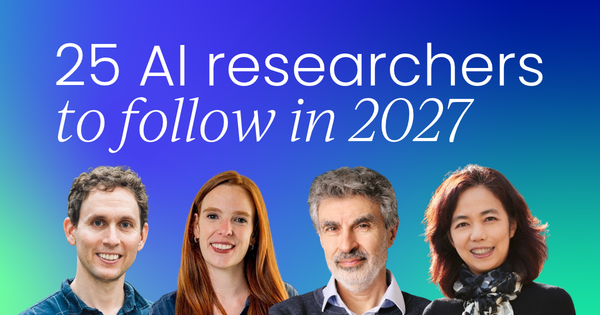
This list is the research-heavy companion to our 25 AI engineers you should be following in 2026.
Every name below runs a lab, leads a research program, or publishes work the rest of the field builds on, grouped by area so your feed covers interpretability, efficiency, reasoning, open science, embodied AI, and safety in one scroll.
Fair warning: your 2027 reading list is about to get longer. Your browser tabs have already made peace with this.
 Ben Bergerson
The interpretability crowd opening the black box
Mechanistic interpretability went from niche subfield to boardroom vocabulary in about two years. These three researchers did much of the opening.
25. Chris Olah (@ch402): Anthropic co-founder and head of its interpretability program, with earlier stints at Google Brain and OpenAI. His team's 2025 circuit tracing work introduced attribution graphs that map how Claude reasons through a prompt, published openly on Transformer Circuits. If a model ever spontaneously brings up the Golden Gate Bridge in your cooking recipe, his team can probably explain why.
24. Neel Nanda (@NeelNanda5): Leads the mechanistic interpretability team at Google DeepMind and created TransformerLens, a go-to library for poking at model internals.
His team recently pivoted toward "pragmatic interpretability," aiming for imperfect-but-useful understanding at concrete safety problems such as deception detection. He has also mentored dozens of early-career researchers, which makes his feed a working curriculum.
23. Jacob Steinhardt (@JacobSteinhardt): UC Berkeley professor and co-founder of Transluce, a nonprofit lab building open tools for AI oversight, including Docent for analyzing large volumes of agent transcripts. He also co-created MMLU, so he has been measuring models since before measuring models became a full-contact sport. Pair his posts with our look at the canary test AI agents keep failing.
The efficiency researchers making your GPU bill smaller
22. Tri Dao (@tri_dao): Co-founder and chief scientist at Together AI, and head of the Dao AI Lab at Princeton. The FlashAttention family has now shipped four generations since 2022, with FlashAttention-4 at MLSys 2026 built around NVIDIA Blackwell. When he posts a kernel benchmark, infrastructure teams start rewriting their roadmaps before lunch.
21. Albert Gu (@_albertgu): CMU professor, Cartesia co-founder, and co-creator of Mamba with Tri Dao. Mamba-3, released in March 2026, reoriented state space models around inference-first design for parallel, agentic workloads. Follow him for the clearest ongoing argument that attention may have competition, plus the occasional reminder that his O(n) beats your O(n²). Read alongside our piece on AI's new era: train once, infer forever.
20. Tim Dettmers (@Tim_Dettmers): CMU assistant professor and Ai2 research scientist who created bitsandbytes and co-authored QLoRA, the reason a lot of fine-tuning happens on a single GPU. His recent work has moved into efficient open coding agents with SERA. He also published a December 2025 essay arguing physical compute limits put AGI out of reach, which made for a lively week in the replies.
 Andrew Lovell
Reasoning and agent researchers setting next year's baseline
Reasoning models and coding agents absorbed most of 2026's research attention, and 2027 looks set to follow. These four shape how both get built and measured.
19. Denny Zhou (@denny_zhou): Founded the reasoning team at Google Brain, where his group developed chain-of-thought, self-consistency, and least-to-most prompting. He moved to Meta Superintelligence Labs in early 2026, a switch the wider world noticed roughly four months later via a LinkedIn title update. Every reasoning model shipped this year owes him a citation or three.
18. Jason Wei (@_jasonwei): First author on the 2022 chain-of-thought prompting paper, then a contributor to o3 and deep research at OpenAI before joining Meta's superintelligence lab in mid-2025. His writing on reinforcement learning and research taste reads like advice from the smartest person at the conference after-party. With Zhou now there too, Meta has enough chain-of-thought expertise to reason through its own org chart.
17. Graham Neubig (@gneubig): CMU associate professor and co-founder and chief scientist of OpenHands, the open-source coding agent platform. His lab's TheAgentCompany benchmark found agents failing roughly 70% of simulated office tasks, a sobering number for anyone writing an agentic roadmap. His feed sits at the meeting point of academic agent research and production tooling, alongside our look at why AI agents struggle with "why" questions.
16. Ofir Press (@OfirPress): Princeton researcher and co-creator of SWE-bench and SWE-agent, the benchmark and harness most coding agent claims eventually get measured against. His newer ProgramBench asks agents to rebuild programs from scratch using only behavior and documentation. He also argued in July 2026 that research ideas catch on when they are very simple, which is excellent advice for papers and for prompt templates.
Open science advocates keeping the field honest
Open releases of data, code, and training logs give everyone outside the frontier labs something to build on and check. These three have built careers on showing their work.
15. Percy Liang (@percyliang): Stanford professor, founding director of the Center for Research on Foundation Models, and the force behind HELM and the Foundation Model Transparency Index. His Marin project runs model development as an open lab, and in September 2026 it launched a 535-billion-parameter training run with every pipeline and log public. Failed experiments included. Most of us keep ours in a folder called final_v3_actually_final.
14. Hanna Hajishirzi: University of Washington professor who co-led Ai2's OLMo and Tülu projects, the reference point for fully open models with data and checkpoints attached. In March 2026, she joined Microsoft AI's superintelligence team while keeping her faculty role. Her next research direction is one of the more interesting open questions heading into 2027.
13. Sara Hooker (@sarahookr): Former VP of research at Cohere and author of "The Hardware Lottery," still the clearest explanation of why winning architectures tend to be the ones that fit available chips. She now runs Adaption Labs, which raised a $50 million seed round in February 2026 to build models that adapt continuously after deployment. Required reading for teams paying for training runs that age faster than milk.
 Andrew Lovell
World model and robotics researchers taking AI off the screen
12. Yann LeCun (@ylecun): Turing Award winner who left Meta and co-founded AMI Labs, which raised $1.03 billion in March 2026 to build world models on his JEPA architecture. He has argued for years that next-token prediction alone falls short of human-level intelligence, and now he has a billion dollars to prove it. His replies on X remain a full-contact sport, and spectators are welcome.
11. Fei-Fei Li (@drfeifei): Stanford professor, ImageNet creator, and co-founder of World Labs, the spatial intelligence company behind the Marble 3D world generator. World Labs secured $1 billion in early 2026, putting her on the other side of the world model debate from LeCun's latent-prediction approach. Follow both and enjoy the most well-funded academic disagreement in tech.
10. Jim Fan (@DrJimFan): Co-leads NVIDIA's GEAR lab with Yuke Zhu and the Project GR00T humanoid foundation model effort. His 2026 work on world action models such as DreamZero puts him at the center of the vision-language-action versus world model debate. He also explains robotics data strategy better than most robotics pitch decks.
9. Sergey Levine (@svlevine): UC Berkeley professor and chief scientist at Physical Intelligence, the startup building one foundation model to run many different robots. His reinforcement learning work underpins much of modern robot learning. When robotics people say "generalist policy," they are usually citing someone in his lab.
8. Chelsea Finn (@chelseabfinn): Stanford professor, Physical Intelligence co-founder, and the researcher behind MAML, the meta-learning method that taught a generation of PhD students to love bilevel optimization. Physical Intelligence's π0.7 model, released in April 2026, follows diverse language instructions in unseen environments and composes skills in new ways. Robots following instructions have rarely looked so academically rigorous.
Safety voices and 2026's biggest transfers
In 2026, researchers changed badges faster than benchmarks got saturated. The top seven mix the people setting the safety agenda with the moves that redrew the frontier lab map.
7. Dan Hendrycks (@DanHendrycks): Director of the Center for AI Safety, creator of MMLU, and the driving force behind Humanity's Last Exam, the expert-level benchmark built with Scale AI and published in Nature in January 2026. He builds the tests models fail today and pass embarrassingly soon after. Follow him for an early read on which leaderboard is about to stop meaning anything.
6. Jan Leike (@janleike): Leads alignment science at Anthropic after co-leading OpenAI's Superalignment team. In September 2026, he wrote that keeping models from lying and cheating increasingly looks solvable, a notable shift in tone from one of the field's most careful voices. When the alignment lead sounds optimistic, it is worth reading the footnotes.
5. Yoshua Bengio (@Yoshua_Bengio): Turing Award winner, the world's most-cited computer scientist, and founder of LawZero, a nonprofit building "Scientist AI," a guardrail system designed to predict and explain risks while agents do the acting. In September 2026, Canada and Germany committed up to CAD $300 million to the effort. His feed is the best counterweight to every "agents will run everything by Q3" thread in your timeline.
4. Dawn Song: UC Berkeley security researcher and Virtue AI co-founder who joined Meta Superintelligence Labs as VP of AI research in June 2026, bringing her co-founders with her. Her work on red teaming, runtime guardrails, and agent security lands right where enterprise agent deployments feel the most pain. Security teams, this one belongs on your shortlist.
3. David Silver: The architect of AlphaGo, AlphaZero, and MuZero left Google DeepMind in January 2026 to found Ineffable Intelligence in London. The company is betting that agents learning from experience and reward, rather than human text, form the path to superintelligence, and it reportedly raised $1.1 billion at a $5.1 billion valuation four months later. London's AI scene now has a heavyweight with a very old-school RL thesis.
2. John Jumper: The 2024 Nobel laureate in chemistry for AlphaFold joined Anthropic in June 2026 after nine years at DeepMind, with AlphaFold colleagues following days later. His next chapter is one of the clearest signals that AI for science is moving inside frontier model labs. Pair it with our look at the rise of the AI scientist.
1. Noam Shazeer: Co-author of "Attention Is All You Need" and Gemini co-lead, who moved to OpenAI in June 2026 less than two years after Google's roughly $2.7 billion Character.AI deal brought him back. His and Jumper's departures coincided with a roughly 5% single-day drop in Alphabet shares. Attention is all you need, apparently, plus a fresh badge. For context on his new home, see our OpenAI case study.
 Ben Bergerson
How to turn this list into an edge
Following 25 researchers is easy. Getting value out of them takes a little structure, especially when the best posts arrive as 14-part threads.
- Read the thread, then the paper: Researcher threads are the best abstracts in AI, written by people who know which result actually matters. Use them to triage, then read the full paper for anything touching your stack.
- Treat lab moves as roadmap signals: When Denny Zhou, John Jumper, and Noam Shazeer change employers within months of each other, research priorities move with them. Expect reasoning, AI for science, and pretraining talent concentration to show up in 2027 model releases.
- Follow the arguments: LeCun versus Li on world models and NVIDIA's world action models versus Physical Intelligence's vision-language-action approach are live debates with billions behind each side. The disagreements tell you where the field is undecided, which is exactly where your architecture choices carry the most risk.
- Map each researcher to a line item: Efficiency work from Dao, Gu, and Dettmers shows up in your inference bill. Interpretability work from Olah and Nanda shapes how teams monitor and debug AI hallucinations. Evaluation work from Press and Hendrycks belongs in every procurement conversation, alongside the governance lessons in 6 mistakes AI leaders keep making with agentic deployments.
Meet the people putting this research into production
Research feeds are great. A room full of engineers and AI leaders who have already deployed the ideas above is better. The Agentic AI Summit Washington, D.C. opens AIAI's 2027 calendar on January 28, 2027.
- Production lessons over press releases: Sessions from teams running generative and agentic systems in real environments, with the evaluation and governance details vendor decks leave out.
- Inference and evaluation in practice: The efficiency and benchmarking work from this list, translated into decisions about cost, latency, and model selection.
- A network that shortens the reading list: Conversations with peers who have already tested the papers you bookmarked, so you can skip straight to what worked.
Your feed tells you what is coming. The summit shows you who is already shipping it. Reserve your place here.


AI accelerator insider insider
Thank you for subscribing
Level up your ai accelerator insider career & network with ai accelerator insider experts.
An email has been successfully sent to confirm your subscription.
 Follow us on LinkedIn